For a decade, the software industry’s answer to every industrial problem has been the same: a subscription. Condition-monitoring dashboards, CMMS licenses, analytics platforms, copilot seats. Plants have bought plenty of them. And yet the moment that actually costs money — a machine down, a technician staring at an alarm screen, production waiting — looks almost exactly like it did twenty years ago, except the person who once knew that machine by sound has since retired.
We think that gap is where the next category of industrial AI gets built. Not more software as a service — troubleshooting as a service. And it’s why we built InduQT.
SaaS sells access. Nobody owns the outcome.
The economics of SaaS shaped what the products became. When you sell seats and subscriptions, the rational product is one that’s always on and never done: dashboards that watch, systems that record, alerts that notify. All useful — and all of them stop precisely at the moment the hard work begins. The alert fires, the work order is logged… and then a human is alone with a fault, a 400-page manual, and a production manager on the phone.
The vendor gets paid whether or not the problem gets solved. That’s not a moral failing; it’s just what the business model optimizes for. If you want a different behavior, you need a different unit of sale.
The category shift: AI agents collapse the marginal cost of expertise. For the first time, it’s economically possible to sell the result — a diagnosed, fixed, documented machine problem — instead of selling access to tools that might help a human get there. When the unit of sale becomes the outcome, the vendor’s incentives and the plant’s incentives finally point the same way.
Why troubleshooting is the beachhead
If outcome-based industrial AI is the category, troubleshooting is the obvious first territory. Unplanned downtime costs manufacturers a fortune — estimates run to hundreds of billions of dollars a year globally — and the knowledge needed to end each incident is scattered: some in OEM manuals, some in a service partner’s private log, and an alarming share in the heads of a maintenance generation now retiring. Every plant knows the feeling of solving the same fault twice because the person who fixed it the first time left.
That’s a problem with a priceable outcome (machine running again), a measurable baseline (time-to-resolution, repeat faults), and a compounding asset nobody has captured (what your own team learns on your own machines).
What TaaS looks like in practice: InduQT
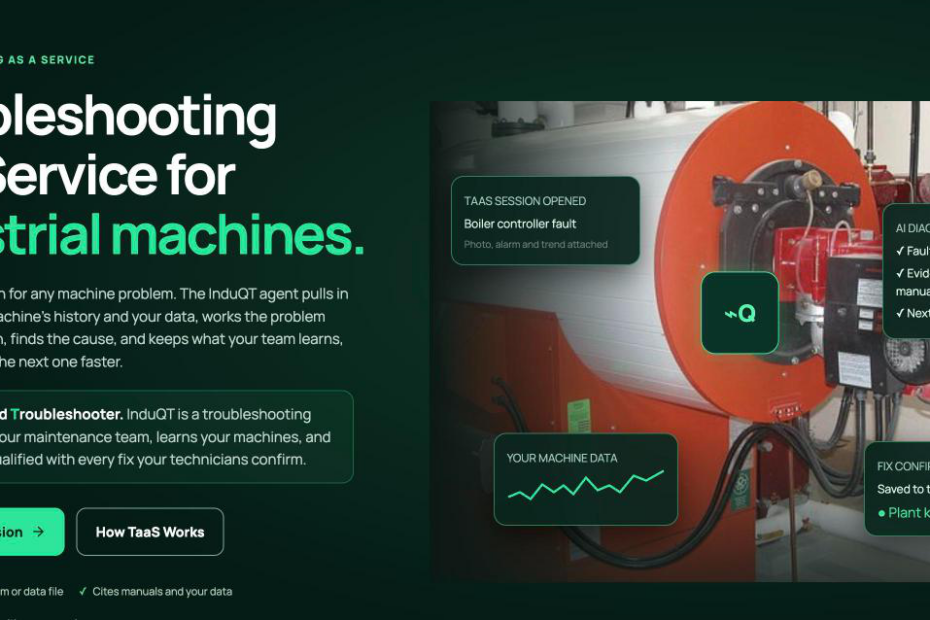
InduQT is our answer, and its shape follows directly from the thesis. The unit isn’t a seat — it’s a TaaS session: a guided investigation that an AI agent runs with your technician, from first symptom to confirmed fix.
1 · Starts where the plant is
A session opens from a photo of an alarm screen, a fault description, or a data file. No integration project, no IT program. Where plants want it, InduQT also connects live — OPC UA, MQTT, historians — and its AI opens investigations on anomalies it sees in the data.
2 · The agent works the problem
It decides what context it needs and pulls it in: the manufacturer’s manual, the machine’s history, your team’s past fixes, work orders, live signals. Then it ranks the likely causes — with cited evidence — and asks for the one measurement that settles the diagnosis.
3 · Closes on a verified fix
The technician records what was found and what was done. The session ends with a confirmed resolution, not a chat transcript. The machine running again is the deliverable.
4 · Knowledge compounds — and stays yours
Every confirmed fix joins the machine’s history and the plant’s knowledge. The first session on a machine starts from the manual; the tenth starts from everything your team has already learned. The name is the thesis: Induct a Qualified Troubleshooter — an agent that joins your maintenance team and gets more qualified with every fix your technicians confirm.
Notice what that model is not. It’s not a dashboard you have to watch. It’s not a copilot seat you pay for whether or not anyone uses it. And the answers don’t accumulate in a vendor’s silo or an OEM’s service log — they accumulate in your plant’s own compounding knowledge base. That last point is, we think, the quiet moat of outcome-based services: the asset being built belongs to the customer, which is exactly why customers keep coming back.
A note on Via Automation — a different venture for a different segment
Readers who know our portfolio will ask how InduQT relates to Via Automation, another venture we back. The short answer: different segment, different model, deliberately so.
Via Automation is an Industrial AI platform for Smart Manufacturing. It serves large, sophisticated manufacturers — semiconductor-grade environments and enterprise factories — where the mandate is maximizing overall equipment effectiveness across whole production lines. That’s platform territory: deep integrations with factory systems, deployed programs, enterprise relationships.
InduQT is an outcome-based service for the maintenance team of any plant. It starts from a single machine problem with zero integration required, and it’s priced on resolved problems, not platform deployments. A ten-person brewery maintenance crew and a mid-market metal fabricator can use it on day one.
The two don’t compete; they bracket the market from opposite ends. Via transforms factory operations where enterprises are ready for a platform. InduQT meets every other plant at the moment a machine is down. If a Via-scale enterprise wants a troubleshooting layer, or an InduQT customer grows into a smart-factory program, each has an obvious neighbor — but we keep the ventures, the products, and the promises distinct.
The bigger bet
This is the same conviction behind everything we build at Kamna — the vertical AI playbook we wrote about with RouteNet: pick one economically decisive workflow, go deeper than any horizontal tool can, and let the product’s daily operation build the moat. Outcome-based services are the next step of that logic. When AI can carry a workflow end-to-end, “software as a service” undersells what’s possible. The service itself — the solved problem — becomes the product.
We expect a wave of these categories across specialized industries over the next few years: quoting as a service, compliance review as a service, coordination as a service. Troubleshooting is simply where we’re proving it first, because the pain is daily, the outcome is unambiguous, and the knowledge asset compounds fastest. For operators and investors asking where AI value actually lands — this is our answer.
See a TaaS session for yourself
InduQT’s live demo replays a real boiler incident — recorded historian data and alarms — and you can watch the diagnosis assemble as the evidence arrives. Or open a session on your own machine problem: it starts from nothing more than a photo.
FAQ
What is Troubleshooting as a Service (TaaS)?
TaaS is an outcome-based model for industrial maintenance: instead of licensing software, a plant opens a session on a specific machine problem, and an AI agent works the investigation with the technician — gathering manuals, history, and data, ranking causes with evidence, and closing only on a confirmed fix. The plant pays for resolved problems, and every session adds to the plant’s own knowledge base.
How is TaaS different from condition monitoring or CMMS software?
Condition monitoring tells you something is wrong; a CMMS records that work happened. Neither owns the middle — the diagnosis and fix. TaaS covers exactly that gap: from first symptom to verified resolution, with the reasoning and the outcome captured.
What is InduQT?
InduQT is Kamna Ventures’ Troubleshooting-as-a-Service venture for industrial machines. A TaaS session starts from a photo, alarm, or data file — no integration required — and InduQT can also connect to live machine data over OPC UA, MQTT, and historian exports. Its agent becomes more qualified with every fix a plant’s technicians confirm. It’s live at induqt.ai.
How are InduQT and Via Automation different?
Via Automation is an Industrial AI platform for Smart Manufacturing aimed at enterprise factories — OEE optimization across production lines, with deep systems integration. InduQT is an outcome-based troubleshooting service for maintenance teams at plants of any size, starting from a single machine problem with no integration. Different segments, different business models, by design.