Case Study · Industrial Distribution
AI Demand Forecasting & Inventory Planning for a Greek Industrial Parts Supplier
A leading Greek supplier of automotive and industrial parts asked us a familiar question: with tens of thousands of SKUs, unpredictable demand, and long supplier lead times, how do you stop choosing between stockouts and a warehouse full of tied-up capital? We built them a custom AI planning platform on top of their existing ERP — and they own it outright.
The client and the challenge
Client
Greek automotive & industrial parts supplier
Domain
Spare-parts distribution — company stock, hubs & stores
Engagement
Proof of concept → custom platform build
Ownership
Client owns the platform IP
Spare-parts distribution is one of the hardest inventory problems there is: an enormous SKU catalog where a few parts move daily and thousands move a handful of times a year, supplier lead times that stretch and drift, stock spread across central warehouses, hubs, and stores — and a P&L squeezed from both sides by lost sales and excess inventory.
Planning ran on experienced people working spreadsheets against ERP exports. The demand history itself was misleading: every past stockout recorded zero sales precisely where demand was strongest, so any forecast trained on raw history inherited the bias. Off-the-shelf inventory tools couldn’t absorb the catalog’s demand diversity, the multi-echelon network, or the house rules planners actually work by.
What we built
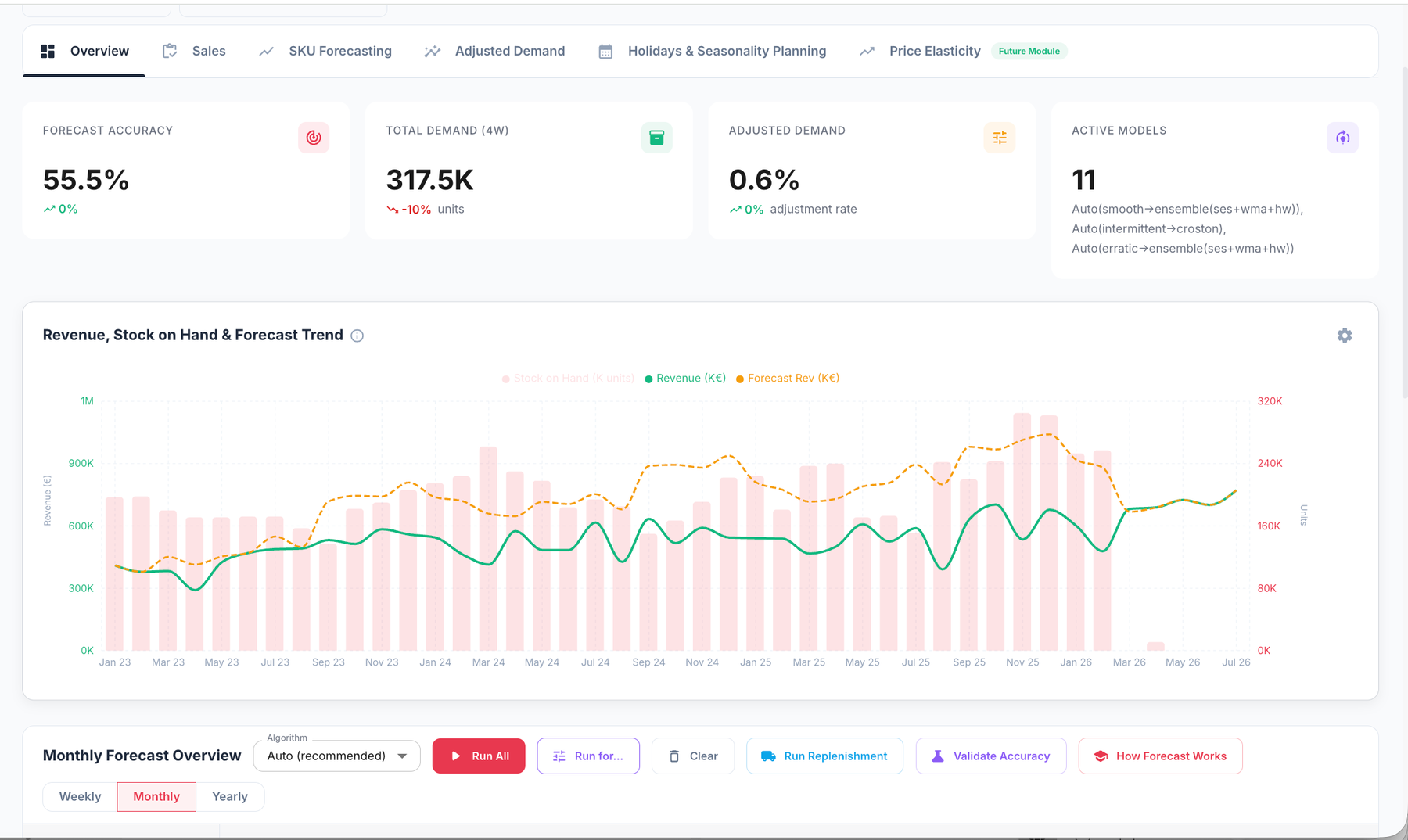
Demand reconstruction
Stockout periods are detected and corrected into an unconstrained demand baseline, so models learn what customers wanted — not what the warehouse happened to have.
Segmented forecasting engine
SKUs are classified by demand behavior — fast, intermittent, seasonal, new, declining — and each class gets the method that suits it, from intermittent-demand specialists to seasonal models and gradient-boosted ML for richer, high-volume series. No single global model.
Multi-echelon replenishment
Reorder points, safety stock, and order-up-to targets computed from forecast demand and lead-time variability — respecting supplier MOQs, order multiples, and ordering calendars, and proposing transfers when one location holds stock another needs.
Supplier lead-time intelligence
Rolling lead-time and variability estimation per supplier and category, feeding service-level-based safety stock instead of one-size-fits-all buffers.
Planner console, not a black box
Planners review, override, and adjust — with campaign handling, abnormal-demand exclusions, and a full audit trail. Every recommendation is explainable back to its inputs.
KPI dashboards
Fill rate, inventory turns, excess and obsolete stock, backorders, supplier performance, and forecast accuracy — tracked continuously against versioned forecasts.
How we ran it
Proof of concept before commitment. Before any platform contract, we built a working proof of concept on the client’s real data and put it in front of their planners and leadership for feedback. That prototype became the agreed baseline for the delivery — an approach we recommend to every client weighing a custom AI build.
Pilot-first scope. Rather than boiling the full SKU universe, the first release targets a pilot slice — fast movers plus a representative sample of intermittent-demand parts across selected suppliers and locations — so forecast quality and replenishment behavior are proven before scaling out.
On top of the ERP, not instead of it. The platform ingests product, sales, inventory, purchasing, and pricing history from the client’s existing ERP through a validated data pipeline. No rip-and-replace, no migration project.
The client owns the asset. The platform — code, models, and the cleaned data foundation — belongs to the client. For a private, family-owned distributor, that turns an operating improvement into a durable, owned capability, and lays the data foundation for future pricing and customer intelligence modules.
Why this engagement is a pattern, not a one-off
This is the vertical AI playbook applied to distribution: pick the workflow where money is actually lost (availability vs. tied-up capital), correct the data at its root (demand reconstruction), use the right model for each demand class instead of one fashionable model for everything, and keep the humans in command with full explainability. It’s the same discipline we apply in our own ventures — like RouteNet, the patent-pending drawing-intelligence AI we built inside Aginera.
Have an inventory, quoting, or planning problem like this?
If your business — or a portfolio company — runs on spreadsheets against an ERP and loses margin to stockouts, excess stock, or manual planning, we’ll show you what a proof of concept on your own data looks like before you commit to anything.