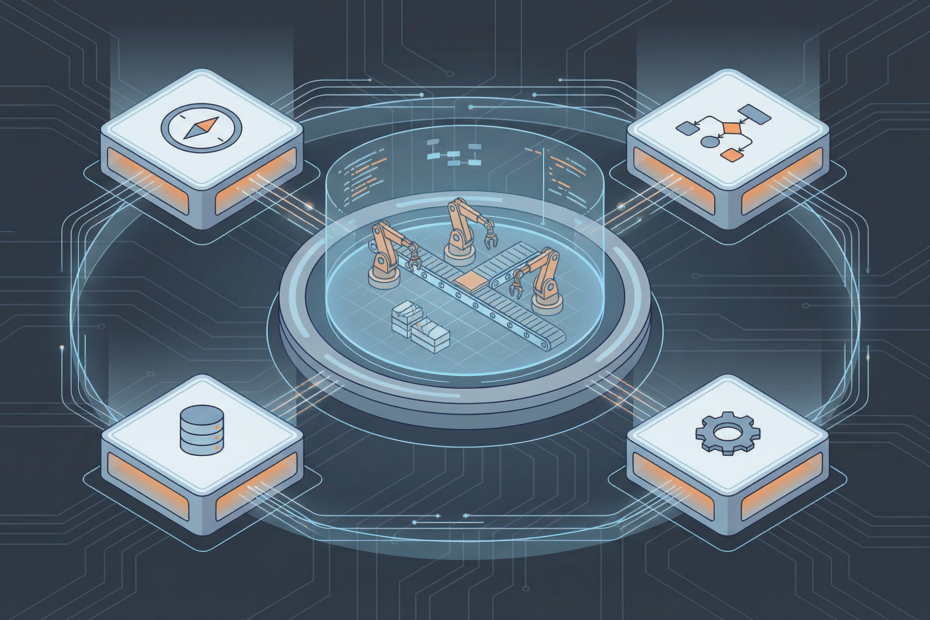
Industrial copilots fail when every query goes through one generic prompt. A robust design uses specialized modes and agents coordinated by a central router.
Four-Layer Copilot Pattern
- Intent Router: classify query into direct response, retrieval, workflow, or deep investigation.
- Tool Registry: unified catalog of built-in tools, external connectors, and workflow tools.
- Planner: generate an execution plan with dependency-aware parallel groups.
- Executor: dispatch tools, stream traces, aggregate evidence, summarize actions.
Routing Skeleton
async function route(query, context) {
  if (context.forceMode) return { mode: context.forceMode };

  const cls = await classifyQuery(query, context); // LLM or rules+LLM
  // modes: direct_llm | rag_qa | workflow | agent | deep_agent
  return cls;
}
Dynamic Tool Registry
class ToolRegistry {
  constructor() {
    this.tools = new Map();
    this.categories = new Map();
  }

  register(tool) {
    this.tools.set(tool.name, tool);
    if (!this.categories.has(tool.category)) this.categories.set(tool.category, []);
    this.categories.get(tool.category).push(tool.name);
  }

  getToolRegistryForLLM() {
    return [...this.categories.entries()].map(([cat, names]) => ({
      category: cat,
      tools: names.map(n => this.tools.get(n))
    }));
  }
}
Planner Output Contract
{
  "goal": "Investigate process drift and propose corrective actions",
  "steps": [
    {"id": 1, "tool": "query_digital_twin", "parallel_group": 1},
    {"id": 2, "tool": "query_process_runs", "parallel_group": 1},
    {"id": 3, "tool": "query_maintenance_history", "parallel_group": 1},
    {"id": 4, "tool": "search_documents", "parallel_group": 1},
    {"id": 5, "tool": "summarize", "parallel_group": 2}
  ]
}
Parallel Executor Pattern
async function executePlan(plan, context, runTool) {
  const grouped = groupBy(plan.steps, s => s.parallel_group || 1);
  const results = [];

  for (const groupId of Object.keys(grouped).sort((a,b) => Number(a)-Number(b))) {
    const groupResults = await Promise.all(
      grouped[groupId].map(async step => ({
        stepId: step.id,
        tool: step.tool,
        result: await runTool(step.tool, step.parameters || {}, context)
      }))
    );
    results.push(...groupResults);
  }
  return results;
}
Traceability and UI Feedback
- Emit
step_start,step_complete, andtool_resultevents. - Store raw tool outputs for tables/charts.
- Persist final reasoning to a decision trace store for future precedent search.
Design Rules That Keep It Reliable
- Prefer deterministic handlers for high-risk operations.
- Use LLM planning, but keep guarded fallback plans.
- Constrain database access to allowlisted tables and schemas.
- Always synthesize with explicit evidence sections and actionable next steps.
If you implement these four layers, your copilot becomes more than chat: it becomes a multi-agent execution system that can investigate, explain, and improve operations with auditable outputs.