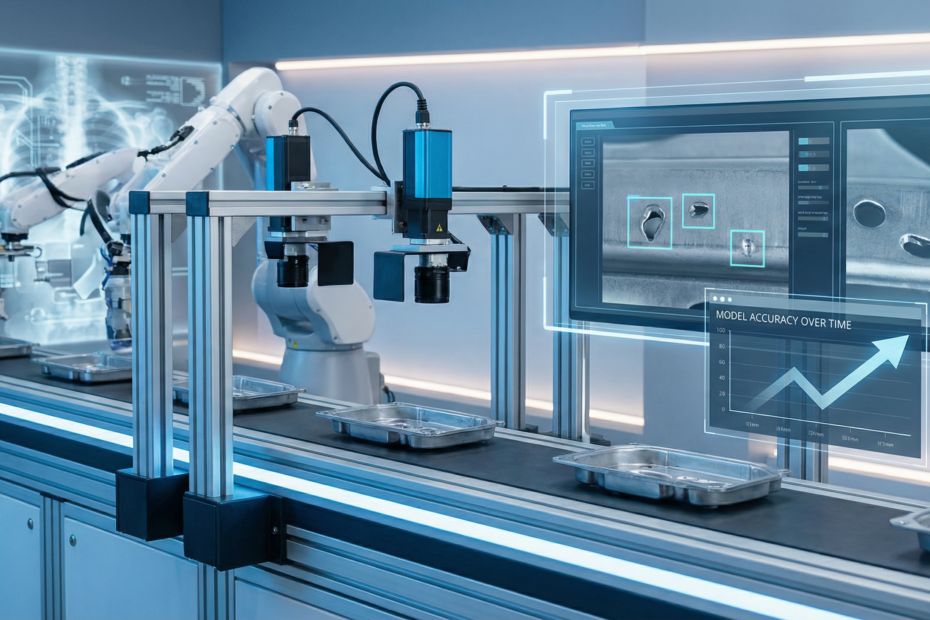
Real-time vision systems fail in production for a predictable reason: the world changes faster than static models. Lighting shifts, part finishes vary, backgrounds evolve, overlays appear, and new defect types emerge. The result is familiar: lab success, short-term production gains, then drift, false alarms, misses, and declining operator trust.
The right question is not “Which model is best?” It is: How do we build a vision system that adapts quickly without pausing operations?
A practical answer comes from a proven clinical imaging pattern (catheter tip classification in live X-ray sequences): a two-speed architecture that combines low-latency inference with near-real-time transfer learning from operator feedback.
The Two-Speed Architecture: Fast Decisions + Rapid Correction
- Speed layer (real-time): lightweight model for line-speed or live-stream decisions.
- Adaptation layer (autocorrect): transfer learning from recent failures and operator corrections to remove false positives and reduce drift.
This pattern maps directly to manufacturing and industrial inspection: keep operations fast, while continuously adapting to edge cases.
Step-by-Step Pipeline for Production Teams
1) Preprocessing and Candidate Generation
- Crop region of interest (ROI)
- Resize for throughput
- Normalize contrast (for example, histogram equalization)
- Generate candidate regions (blobs/components/proposals)
- Crop compact thumbnails (for example, 48×48) for classification
Why it works: you avoid heavy inference across every pixel when fast candidate generation is enough.
2) Real-Time Classification (Latency First)
A compact CNN classifies each candidate with strict latency budgets. Typical decisions include:
- Defect vs non-defect
- Scratch vs dent
- Correct assembly feature vs artifact
- Acceptable vs unacceptable weld behavior
3) Failure Capture: Convert Operators into Training Signal
When the fast path misclassifies, capture:
- False positives and false negatives
- Operator corrections and QA dispositions
- Rework tickets and downstream test feedback
This creates high-value production labels with minimal workflow disruption.
4) Near-Real-Time Transfer Learning
Fine-tune a stronger local model (for line/SKU/study context) using recent production samples. This local model learns context-specific artifacts quickly without retraining the global model end-to-end.
5) Autocorrect Pass
Apply the local adaptive model to re-evaluate uncertain or noisy candidates and remove nuisance alarms.
6) Continuous Improvement with Fewer Interventions
As local data grows, repeated artifacts require less manual correction and trust improves across shifts and product variants.
Why This Is Agentic AI (Not Just Another Model)
This is an observe -> decide -> act -> learn loop:
- Detect uncertainty/failure
- Trigger data capture automatically
- Build incremental training sets
- Train and deploy updates
- Track confidence, drift, and business impact
High-Value Manufacturing Use Cases
- Surface and cosmetic defect inspection
- Assembly verification (missing/incorrect components)
- OCR and label validation in variable conditions
- Weld inspection with spatter/artifact suppression
- CAD-to-image conformance checks
- Document + image workflows (QA reports, redlines, evidence photos)
MLOps That Actually Works: Global Stability + Local Agility
- Global model: scheduled updates (for example weekly) with governance and regression checks.
- Local adaptive model: rapid fixes for drift, artifacts, and line-specific variance.
This split gives both consistency and speed-to-correction.
From Candidate Generators to Detectors
A practical evolution path:
- Start with candidate generation + lightweight classifier for fast pilot outcomes.
- Move to end-to-end detectors when you need stronger robustness and less handcrafted preprocessing.
How Kamna Ventures Helps
Most SMEs do not need a research lab. They need a production path operators trust.
- AI Opportunity Sprint (2 weeks): prioritize 3-5 ROI workflows, assess data readiness, define pilot plan.
- Pilot (30-45 days): deploy real-time model plus autocorrect loop with operator feedback.
- Scale (60-90 days): expand across lines/SKUs with governance, monitoring, and continuous improvement.
- Thumbnail-based pipelines are strong when compute is constrained and iteration speed matters.
- K-fold validation helps choose robust lightweight real-time models.
- Transfer learning is the fastest way to adapt to new artifacts without full retraining.
If you are a manufacturing owner or GM dealing with quality escapes, inspection labor cost, or slow review/quoting cycles, Kamna can help you deploy an agentic vision workflow that improves itself over time. Book a discovery call.