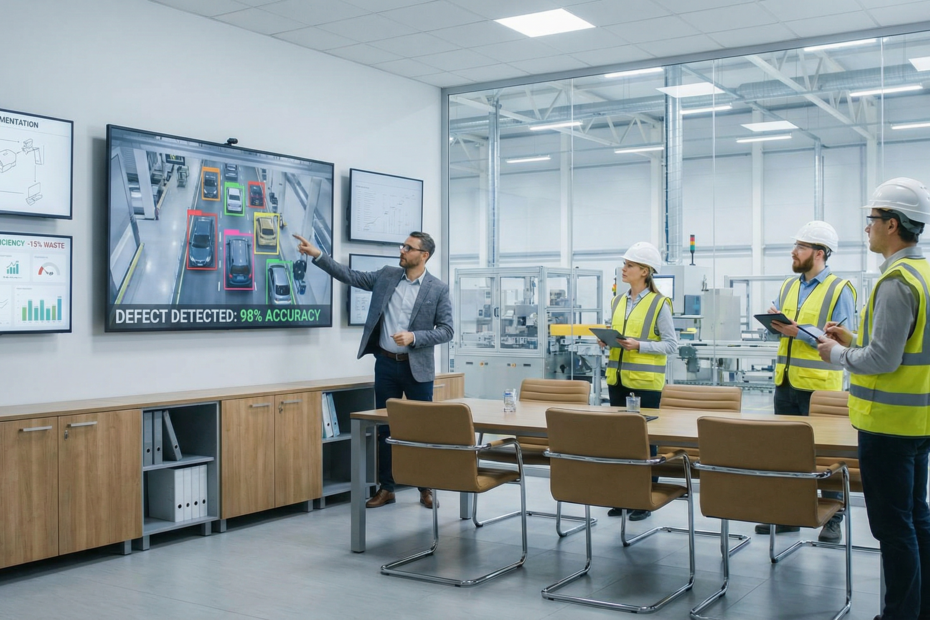
Computer vision for manufacturing is more than algorithms. It’s cameras, lighting, integration, and workflows. When you engage a consultant, you’re not just buying a model — you’re buying a system that works in your environment. This guide explains what computer vision consulting looks like, what to prepare, and what questions to ask. Whether you’re looking at quality inspection, measurement, or sorting, understanding the full scope will help you set expectations and succeed.
What Computer Vision Consulting Looks Like
Many manufacturers assume computer vision is “just the AI.” It’s not. A successful deployment involves:
- Cameras and lenses: Resolution, frame rate, field of view — matched to your defect size, part speed, and inspection zone
- Lighting: Directional, controlled illumination that highlights defects and suppresses ambient interference. Bad lighting is the biggest cause of pilot failure
- Integration: How the system connects to your line — PLC, MES, or standalone — and what happens when it flags a defect
- Workflows: Human-in-the-loop for uncertain cases, retraining cadence, and governance for new defect types
A good consultant addresses all of these. They’ll assess your setup, specify hardware, design the labeling strategy, build the model, and validate on production. Our computer vision quality inspection pillar covers the full stack — from hardware to deployment.
Typical Engagement Phases
Assessment (1–2 weeks)
The consultant visits your facility, reviews your parts, defect types, and line conditions. They’ll ask about defect rates, defect categories, and quality criteria. Deliverables: a feasibility report, hardware recommendations, and a proposed scope for the proof of concept.
Proof of Concept (4–8 weeks)
Build a working system for a subset of defects or parts. You provide sample images and defect labels; the consultant builds and trains the model. They’ll validate on held-out data and, if possible, run a short trial on the line. Deliverables: a functional system, performance metrics, and a go/no-go recommendation.
Production Deployment (4–8 weeks)
Harden the system for production: integrate with your line, set up monitoring, train operators, and document procedures. Deliverables: a production-ready system, documentation, and handoff to your team.
Total timeline: 10–18 weeks from kickoff to production, depending on complexity. Our AI Incubation Lab runs computer vision projects in this structure — discovery, pilot, scale.
What You Need to Prepare
Sample images: Representative parts — good and defective — under conditions similar to production. Aim for 500–2000+ images per defect type. More variety (lighting, angles, part variants) improves robustness.
Defect categories: A clear definition of what counts as a defect. Is a scratch a defect? What size? What severity? Inconsistent definitions lead to inconsistent labels and poor model performance.
Quality criteria: How do you measure success? Defect escape rate, false positive rate, throughput? Agree on metrics before the pilot.
Access: The consultant needs to see your line, parts, and (if possible) run a trial. Plan for site visits and operator time.
Hardware Considerations
Cameras: Resolution must be sufficient to see the defects you care about. Calculate pixel-per-defect: if your smallest defect is 0.5mm and you need 10 pixels across it, work backward from sensor size and working distance. Frame rate must match line speed to avoid motion blur.
GPUs: Inference can run on edge devices (Jetson, industrial PCs) or in the cloud. Edge reduces latency and keeps data on-site; cloud simplifies updates and scaling. The consultant will recommend based on your throughput and latency requirements.
Edge vs cloud: Edge is typical for real-time inspection on the line. Cloud may be used for batch analysis, model training, or lower-priority applications. Hybrid setups are common.
Common Questions
“How many images do we need?”
Depends on defect complexity and variety. Simple binary pass/fail with consistent defects: 500–1000. Multiple defect types, rare defects, or high variability: 1500–3000+. Rare defects need enough examples that the model can learn them — consider oversampling or synthetic augmentation.
“What if defects are rare?”
Rare defects are hard but not impossible. You may need to collect over time, use synthetic data, or start with anomaly detection (learn “good” and flag “different”) instead of supervised classification. The consultant will recommend based on your defect distribution.
“Can it run on our existing cameras?”
Maybe. Existing cameras may have insufficient resolution, wrong field of view, or poor lighting. The assessment phase will determine if upgrades are needed. Don’t assume — validate with sample images from your current setup.
ROI Expectations for Different Use Cases
Inspection: Reduce defect escape rate, cut manual inspection labor, enable 100% inspection where sampling was used before. ROI typically 6–18 months for moderate volume.
Measurement: Automated dimensional checks, SPC integration. ROI from labor savings and reduced measurement variability.
Sorting: Classify parts by type, grade, or defect for routing. ROI from labor savings and consistency.
Exact payback depends on volume, labor cost, and defect rates. The consultant should provide a rough ROI model during assessment.
How Kamna Ventures Approaches Computer Vision Projects
At Kamna Ventures, we treat computer vision as a full-stack problem. We start with assessment: your parts, defects, and line. We specify hardware (cameras, lighting) before we train — because a model trained on bad images will fail in production. We design labeling protocols and validate on production-like data. We integrate with your systems and plan for monitoring and retraining.
Our AI Incubation Lab runs computer vision pilots in 6–10 weeks, from discovery to working system. We focus on the highest-impact defect first, nail it, then expand. That approach de-risks technically and organizationally.
Ready to explore computer vision for your manufacturing? See our AI Incubation Lab and our computer vision quality inspection capabilities. We’ll help you understand what’s feasible, what to prepare, and what to expect from day one.