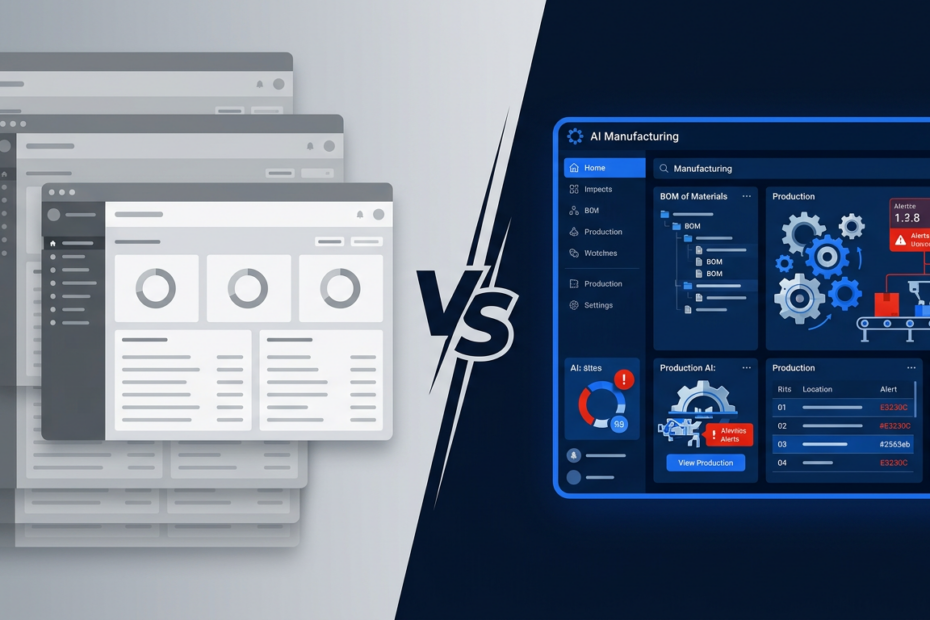
Manufacturing software has a dirty secret: most of the tools marketed to manufacturers weren’t built for manufacturing. They were built for “supply chain” or “inventory” or “demand planning” as generic categories, then lightly adapted with manufacturing terminology. The result is software that looks good in a demo but fails in production — because it doesn’t understand BOMs, doesn’t handle job shop variability, and treats manufacturing like a simpler version of retail distribution.
This is the fundamental tension between horizontal SaaS and vertical AI. Horizontal tools solve a broad problem adequately. Vertical AI solves a specific problem deeply. For manufacturing SMBs — where the margin for error is thin, the workflows are complex, and the data is messy — that difference isn’t academic. It’s the difference between a tool that sits unused after 90 days and a system that transforms operations.
What Horizontal SaaS Gets Wrong About Manufacturing
Horizontal SaaS tools have proliferated in the planning and inventory space. They promise AI-powered forecasting, demand planning, and inventory optimisation. Many of them deliver real value — in retail, distribution, and e-commerce. But when applied to manufacturing, they hit structural limitations that no amount of configuration can fix.
Single-function thinking in a multi-function world
Horizontal tools are typically single-function: inventory planning, demand forecasting, or supplier management as isolated modules. Manufacturing doesn’t work that way. A change in customer demand cascades through production scheduling, material requirements, capacity planning, supplier orders, and quality requirements — simultaneously. When your demand planning tool doesn’t talk to your production scheduling, and your inventory planner doesn’t understand your BOM structure, you end up with planners manually stitching together data from multiple systems. That’s not automation; that’s expensive coordination.
Recommendation-only vs action-oriented
Most horizontal SaaS tools generate recommendations: “You should reorder 500 units of SKU-1234.” Then a human has to evaluate the recommendation, open the ERP, create a purchase order, check the supplier’s availability, and execute. According to Gartner, 60% of planning tool recommendations are never acted upon — not because they’re wrong, but because the friction of execution is too high. The tool suggests; the human still does all the work. The value of a recommendation that nobody acts on is zero.
Clean data assumptions in a messy data reality
Horizontal tools assume clean, structured data. Their onboarding process involves data mapping, cleansing, and normalisation before the tool can function. For manufacturing SMBs running legacy ERPs, clean data is a fantasy. Item master records have duplicates, inconsistent units of measure, and incomplete BOMs. Transaction history has gaps. Supplier data lives in email threads, not structured databases. By the time you’ve cleaned your data enough to satisfy a horizontal tool, you’ve spent 3–6 months and significant budget on data preparation — before getting any value.
No understanding of manufacturing context
This is the core issue. Manufacturing has domain-specific concepts that horizontal tools don’t model:
- Bill of Materials (BOM): Multi-level structures where finished goods are composed of sub-assemblies, which are composed of components and raw materials. Planning at the finished-good level without BOM explosion produces meaningless recommendations.
- Engineering Change Orders (ECOs): When a design changes, materials change. Active ECOs affect what to order, what to use up, and what becomes obsolete. Horizontal tools don’t track ECOs.
- Work-in-Progress (WIP): Manufacturing has inventory at multiple stages — raw material, in-process, finished good. Effective planning accounts for WIP; horizontal tools see only on-hand and on-order.
- Job shop and make-to-order dynamics: Many SMB manufacturers don’t produce standard products to stock. They produce custom or semi-custom products to order, with variable routings and material requirements. Horizontal tools built for make-to-stock environments can’t handle this variability.
- Multi-site operations: A manufacturer with two plants and a warehouse has different inventories, capabilities, and constraints at each location. Inter-site transfers, work-order allocation, and consolidated planning require location-aware intelligence.
- Quality and compliance: Material certifications, lot traceability, and incoming inspection requirements are integral to manufacturing procurement. Horizontal tools don’t model quality as part of the planning process.
What Vertical AI Does Differently
Vertical AI is purpose-built for a specific industry. It encodes domain knowledge into its models, agents, and workflows. For manufacturing, this means AI that understands BOMs, speaks the language of production, handles messy ERP data, and automates complete workflows — not just the planning step.
Domain-specific models trained on manufacturing data
Vertical AI models are trained on manufacturing data: production schedules, BOM structures, supplier performance records, quality data, and shop floor transactions. They understand that a demand signal for a finished good implies demand for its components. They know that supplier lead times vary by commodity and geography. They recognise seasonal patterns specific to manufacturing verticals — construction equipment peaks in spring, HVAC components peak before summer, agricultural machinery aligns with planting and harvest cycles. This domain knowledge isn’t configuration; it’s embedded in the model architecture.
Multi-system agents that bridge silos
Agentic AI doesn’t just live in one system. AI agents can read from the ERP, check the MES for production status, query the quality system for supplier rejection rates, and pull shipping data from the logistics platform. They synthesize information across systems to make decisions that no single-system tool can make. When an agent detects that a key supplier’s quality has degraded (from the quality system), it can adjust the replenishment plan (in the ERP), flag the risk for the buyer (via notification), and trigger a re-sourcing search (from the supplier database) — all as one coordinated workflow.
Handles messy, imperfect data
Manufacturing data is never clean. Vertical AI is designed for this reality. It uses fuzzy matching to reconcile duplicate items, imputes missing values using domain-specific logic (not generic statistical methods), and learns to work with the data quality you have — not the data quality a horizontal tool demands. A practical example: if your ERP has three entries for the same supplier with slightly different names and codes, a vertical AI agent recognises them as the same entity, consolidates their performance data, and presents a unified view. A horizontal tool would treat them as three separate suppliers.
Automates complete workflows, not just analysis
This is where vertical AI diverges most sharply from horizontal SaaS. Horizontal tools analyse and recommend. Vertical AI agents execute. An AI supply chain agent doesn’t just tell you to reorder — it generates the PO, selects the supplier based on current performance and availability, applies the correct pricing and terms, routes for approval, and sends the order. It monitors the order through delivery, matches the invoice, and updates inventory. The planner manages by exception, intervening only when the agent flags an anomaly it can’t handle autonomously.
How Vertical AI Has Transformed Other Industries
Manufacturing isn’t the first industry to face the horizontal vs vertical question. The pattern is well-established:
- Legal technology: Generic document management tools gave way to purpose-built legal AI that understands contracts, precedent, clause risk, and regulatory compliance. Tools like Harvey and Ironclad don’t just store documents — they understand legal context. Law firms that adopted vertical AI reduced contract review time by 60–80%.
- Healthcare: Horizontal analytics platforms couldn’t handle the complexity of clinical workflows, compliance requirements, and medical terminology. Vertical AI systems built for healthcare — understanding ICD codes, clinical pathways, drug interactions, and regulatory requirements — have transformed diagnostics, clinical documentation, and revenue cycle management. Radiology AI alone is projected to be a $3B market by 2028.
- Financial services: Generic data tools couldn’t provide the risk modelling, compliance monitoring, and transaction surveillance that financial institutions need. Vertical AI built for finance understands regulatory frameworks, market microstructure, and risk calculation methodologies. Fraud detection AI, purpose-built for financial transactions, catches 95% of fraud that rule-based systems miss.
- Agriculture: Precision agriculture replaced generic data analytics with purpose-built AI that understands soil types, crop physiology, weather patterns, and pest cycles. The result: 15–25% yield improvements and 20–30% reduction in input costs. The AI isn’t just analysing farm data — it’s making agronomic decisions.
Manufacturing is following the same trajectory. The generic tools came first. Now purpose-built vertical AI is emerging — and the performance gap is widening.
Why Manufacturing Is the Next Frontier for Vertical AI
Manufacturing has several characteristics that make it particularly ripe for vertical AI disruption:
- High complexity, low digitisation: Manufacturing workflows are complex (BOMs, routings, quality requirements, multi-site operations), but most SMBs are still running on legacy systems with minimal automation. The gap between operational complexity and digital capability is enormous — and that gap is where vertical AI creates value.
- Rich data, poor utilisation: Manufacturing SMBs generate vast amounts of data — production logs, quality records, supplier transactions, machine data — but use almost none of it for decision-making. According to IDC, manufacturing firms use less than 5% of their operational data for analytics. Vertical AI unlocks that data by understanding its context and applying it to real decisions.
- Skilled labor shortage: Manufacturing faces a critical workforce shortage — an estimated 2.1 million unfilled manufacturing jobs in the US alone by 2030 (Deloitte/Manufacturing Institute). European manufacturing faces similar challenges, with 80% of EU manufacturers reporting difficulty finding skilled workers. AI doesn’t replace workers; it multiplies the impact of the workers you have.
- High-stakes decisions: Inventory, procurement, quality, and scheduling decisions in manufacturing have direct financial consequences. A bad forecast doesn’t just cause an Excel error — it causes a stockout that shuts down a production line or excess inventory that burns working capital. The ROI of better decisions is immediate and measurable.
- Multi-system environments: Manufacturing SMBs typically run 5–15 different systems (ERP, MES, QMS, CRM, CAD, accounting). Horizontal tools add another silo. Vertical AI agents bridge these systems, creating intelligence that spans the full operational picture.
Manufacturers Don’t Need Another Dashboard — They Need AI That Does the Work
This is the fundamental insight that separates vertical AI from horizontal SaaS. Manufacturing leaders aren’t asking for more visibility. They have dashboards — dozens of them. What they lack is capacity. The planner who’s manually creating 50 POs a day doesn’t need a prettier view of inventory — they need an agent that creates the POs. The quality manager reviewing inspection results doesn’t need another analytics dashboard — they need a computer vision system that inspects parts automatically and routes defects for disposition.
The shift from “tools that show” to “agents that do” is the defining characteristic of vertical AI. It’s the difference between a recommendation engine and an execution engine. And for manufacturing SMBs without the luxury of large planning teams or dedicated IT staff, execution-oriented AI is the only kind that delivers sustainable ROI.
Making the Shift: From Horizontal Tools to Vertical AI
If you’re currently using horizontal planning or procurement tools, the transition to vertical AI doesn’t have to be disruptive. Here’s a practical approach:
- Audit your current tool’s limitations: Where is your current tool falling short? Which recommendations go unacted upon? Where do your planners spend time translating between the tool and reality? Those gaps are where vertical AI delivers immediate value.
- Start with one high-impact workflow: Don’t try to replace everything at once. Pick one workflow — inventory replenishment, engineering document processing, supplier evaluation, or quality inspection — and deploy vertical AI there. Prove the value, then expand.
- Measure outcomes, not features: Horizontal tools compete on features — more dashboards, more reports, more configuration options. Vertical AI competes on outcomes — transactions automated, hours saved, errors prevented, working capital freed. Measure what matters.
- Choose AI that works with your existing systems: Vertical AI shouldn’t require you to replace your ERP or re-platform your operations. It should work as an intelligent layer on top of your existing systems, extracting data via APIs, applying AI, and pushing actions back. If a vendor requires rip-and-replace, they’re not solving your problem — they’re creating a new one.
Frequently Asked Questions
What is the difference between vertical AI and vertical SaaS?
Vertical SaaS is industry-specific software — it serves one industry (e.g., manufacturing) but operates like traditional software: structured workflows, dashboards, and reports. Vertical AI goes further: it uses machine learning, natural language processing, and autonomous agents to understand context, learn from data, and execute actions. Vertical SaaS shows you information. Vertical AI acts on it. The distinction matters because the value of AI in manufacturing comes from automation and decision-making, not from another software interface.
Is vertical AI more expensive than horizontal SaaS tools?
Not necessarily. Horizontal SaaS tools typically charge per user or per transaction, and costs scale linearly. Vertical AI solutions often deliver enough automation to reduce headcount needs or redeploy capacity, making the net cost lower despite a higher software price. More importantly, the ROI calculation is different: a horizontal tool that saves 30 minutes per day per planner has limited ROI. A vertical AI agent that automates 80% of a workflow has transformative ROI. Total cost of ownership — including implementation, data preparation, integration, and the cost of unacted-upon recommendations — usually favors vertical AI for manufacturers with meaningful operational complexity.
Can vertical AI handle custom or make-to-order manufacturing?
Yes — and this is one of the key advantages over horizontal tools. Vertical AI built for manufacturing understands that demand isn’t always forecastable in the traditional sense. For make-to-order environments, AI agents work with customer order pipelines, quote conversion rates, and project schedules to plan materials and capacity. They can process engineering specifications from CAD drawings, estimate material requirements for new products, and adapt to the variability that defines job shop and custom manufacturing. Horizontal tools built for steady-state, make-to-stock environments simply can’t do this.
How does vertical AI handle the messy data in manufacturing ERPs?
Vertical AI is designed for data imperfection. It uses domain-aware data reconciliation — fuzzy matching for items and suppliers, intelligent defaults for missing fields, and anomaly detection for data errors. Rather than requiring a 6-month data cleansing project before go-live, vertical AI starts working with your data as-is and improves data quality as a byproduct of its operation. Over time, the AI flags data issues, suggests corrections, and learns to work around known data quality limitations. This is fundamentally different from horizontal tools that refuse to function until data meets their quality thresholds.
Why haven’t horizontal SaaS tools added manufacturing-specific capabilities?
Some have tried, but the challenge is architectural. Horizontal tools are built on generic data models — SKUs, locations, orders. Adding BOM support, ECO tracking, WIP awareness, and multi-level planning requires rearchitecting the core system, not just adding a feature. It’s the same reason a generic CRM can’t become a purpose-built healthcare EMR by adding some fields. The domain knowledge needs to be foundational, not cosmetic. This is why vertical solutions consistently outperform horizontal ones in complex, domain-specific applications.
The Future Belongs to Purpose-Built Intelligence
The horizontal vs vertical debate in manufacturing AI isn’t about which is “better” in the abstract. It’s about which delivers outcomes for your specific operational reality. If you’re a distributor with simple demand patterns and clean data, a horizontal tool may be fine. If you’re a manufacturer with BOM complexity, multi-site operations, messy ERP data, and workflows that require execution — not just recommendations — vertical AI is the path to real transformation.
Kamna builds vertical AI specifically for manufacturing operations. Our agents don’t just plan — they execute. They work on top of your existing ERP, understand your manufacturing context, and handle the messy reality of shop floor operations. If you’re ready to move beyond dashboards and recommendations to AI that actually does the work, explore our AI-powered supply chain intelligence or start with our AI Incubation Lab to see vertical AI in action on your data, with your workflows, in 30–45 days.