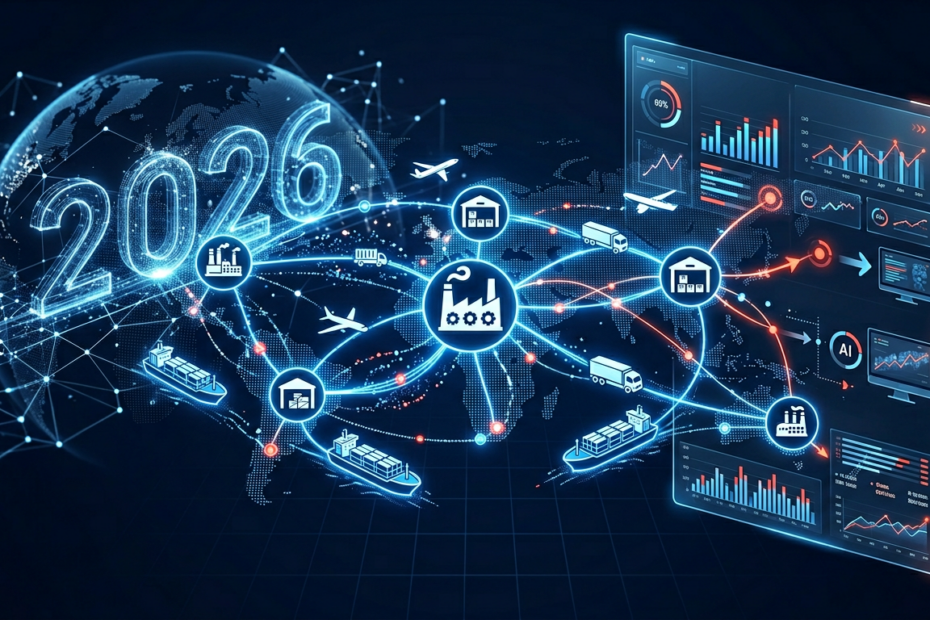
Mid-market manufacturers — companies in the €10M to €200M revenue range — are caught in a difficult position. They face the same supply chain volatility as large enterprises: tariff shifts, geopolitical disruption, unpredictable demand, and supplier unreliability. But they don’t have the budgets, data science teams, or multi-year implementation timelines that Fortune 500 companies use to deploy supply chain AI. The result is a gap between what’s promised and what actually works at this scale. This post separates hype from reality, based on what we see working in production across manufacturing SMBs in Europe and North America in 2026.
Why 2026 Is Different: The Context Has Changed
Three forces have converged to make supply chain AI both more urgent and more accessible for mid-market manufacturers.
Tariffs and trade fragmentation. The return of aggressive tariff policies — particularly US tariffs on Chinese imports exceeding 60% in some categories, EU Carbon Border Adjustment Mechanism (CBAM) compliance costs, and retaliatory measures — has made sourcing decisions vastly more complex. A mid-market manufacturer sourcing components from three countries now faces a tariff calculation that changes quarterly. Manual spreadsheet-based planning cannot keep up.
AI cost and capability inflection. The cost of running large language models has dropped roughly 90% since 2023. Foundation models now handle structured data tasks — demand forecasting, anomaly detection, document understanding — that previously required custom ML teams. A mid-market manufacturer can deploy meaningful AI on a budget that would have been impossible two years ago.
ERP data maturity. Most mid-market manufacturers have been running ERP systems (SAP Business One, Microsoft Dynamics, Epicor, Infor) for 10–20 years. They have years of transactional data: purchase orders, sales orders, inventory movements, production records. This data is messy, but it’s there — and modern AI is much better at working with messy, real-world data than the clean-room requirements of traditional analytics.
What Works Now: Proven Supply Chain AI Capabilities
These capabilities are deployed, delivering ROI, and achievable for mid-market manufacturers in 2026. They are not theoretical.
Demand Sensing from ERP + External Data
Traditional demand planning uses historical sales data and manual adjustments. AI-driven demand sensing layers in external signals — raw material price indices, shipping rate fluctuations, weather patterns, economic indicators, even competitor activity from public sources — to produce forecasts that adapt weekly or daily instead of monthly or quarterly. Mid-market manufacturers using AI demand sensing report 25–40% improvement in forecast accuracy compared to spreadsheet-based methods. That translates directly to less excess inventory and fewer stockouts.
Automated Purchase Order Generation
When demand signals, inventory positions, and supplier lead times are connected, purchase order generation can be automated. The AI reviews current stock against forecasted demand, applies reorder rules (minimum order quantities, economic order quantities, supplier constraints), and generates PO drafts for review or auto-submission. A manufacturer with 2,000 SKUs might generate 50–100 POs per week. Automating this saves 15–25 hours of procurement staff time weekly and reduces ordering errors by 60–80%. This is one of the highest-ROI supply chain AI workflows we see. Learn more about AI-driven supply chain and inventory optimization.
Supplier Risk Scoring
Every manufacturer has been burned by a supplier failure. AI-based supplier risk scoring aggregates your internal data (on-time delivery rates, quality rejection rates, price variance history) with external signals (financial health indicators, news sentiment, geographic risk factors, sanctions lists) to produce a dynamic risk score for each supplier. This shifts supplier management from reactive to proactive. When a supplier’s risk score deteriorates, procurement gets an alert before the delivery fails — not after. Mid-market manufacturers using AI risk scoring report catching 30–50% of supplier issues before they impact production.
Inventory Position Optimization
Most mid-market manufacturers carry too much of the wrong inventory and not enough of the right inventory. AI-based inventory optimization calculates optimal safety stock, reorder points, and stocking levels at the SKU-location level, accounting for demand variability, lead time variability, service level targets, and carrying costs. The improvement is typically a 15–30% reduction in total inventory value while simultaneously improving fill rates by 5–10 percentage points. For a manufacturer carrying €5M in inventory, that’s €750K to €1.5M freed up in working capital.
Exception-Based Management
The most underrated supply chain AI capability isn’t a fancy algorithm — it’s filtering. A mid-market manufacturer’s supply chain generates hundreds of signals daily: incoming POs, shipment updates, quality results, demand changes, price changes. Humans can’t process all of them. AI-driven exception management surfaces only what matters: the late shipment that will stop a production line, the demand spike that will cause a stockout, the price increase that should trigger a re-sourcing decision. Everything else is handled automatically or deprioritized. Supply chain managers report spending 40–60% less time on routine monitoring and more time on strategic decisions.
What’s Emerging: Real but Early
These capabilities are being piloted and showing promise, but they aren’t yet mature enough for most mid-market manufacturers to deploy as standalone solutions.
Multi-Agent Orchestration Across Procurement, Production, and Logistics
Instead of separate AI tools for demand, inventory, procurement, and logistics, multi-agent architectures coordinate across these functions. A procurement agent negotiates with a logistics agent to optimize total landed cost, while a production scheduling agent adjusts sequences based on material availability. This cross-functional coordination is where agentic AI in manufacturing is heading. Early adopters report 10–15% improvement in total supply chain cost beyond what single-function AI delivers. But the integration complexity is real — expect 6–12 months for a meaningful deployment.
Predictive Disruption Handling
AI systems that monitor geopolitical events, port congestion, weather systems, and supplier financial health to predict disruptions before they happen — and automatically trigger mitigation actions (alternative sourcing, safety stock adjustments, customer communication). The prediction accuracy is improving rapidly, but the automated mitigation piece is still mostly human-approved rather than fully autonomous. Expect this to mature significantly by late 2026 and into 2027.
Dynamic Tariff and Trade Compliance Optimization
With tariff regimes changing frequently, AI that dynamically optimizes sourcing and routing decisions based on current and projected tariff structures is emerging. For manufacturers sourcing across borders — common for European manufacturers working with Asian and North American suppliers — this can save 3–8% on total landed costs. The challenge is keeping the tariff and trade rule databases current; this is an area where vendor maturity varies widely.
What’s Still Overhyped
Not everything labeled “supply chain AI” delivers value. Here’s what to be skeptical about.
Fully autonomous supply chains. No mid-market manufacturer should expect or want a fully autonomous supply chain in 2026. The complexity of manufacturing — custom products, engineering changes, supplier relationships built on trust, regulatory requirements — means human judgment remains essential. The best AI augments human decision-making; it doesn’t replace it. Vendors promising “autonomous supply chain management” are selling a vision, not a product.
AI replacing all human planners. AI handles data processing, pattern recognition, and routine decisions far better than humans. But supply chain planning involves negotiation, relationship management, ethical judgment, and handling true exceptions that have never been seen before. The realistic outcome is that one planner with AI can do the work of three planners without it — not that planners are eliminated.
Plug-and-play supply chain AI. Any vendor claiming their AI works out of the box with no configuration, data integration, or tuning is oversimplifying. Even the best supply chain AI requires connecting to your ERP, mapping your data model, configuring business rules, and a period of learning. The question isn’t whether configuration is needed, but whether it takes 90 days or 18 months.
A Framework for Evaluating Supply Chain AI Vendors
Mid-market manufacturers should assess vendors against these five criteria before committing budget.
1. Does It Integrate with Your ERP?
If the vendor has a pre-built connector for your ERP system, deployment time drops dramatically. If they need to build a custom integration, add 2–4 months and significant cost. Ask for references from manufacturers running your specific ERP version. The integration question is the single biggest predictor of time-to-value.
2. Does It Automate or Just Recommend?
Many tools generate recommendations — “you should reorder this SKU” — but stop short of executing. The ROI difference is massive. A tool that generates a PO draft in your ERP saves 15 minutes per order. A tool that shows a dashboard saying “consider reordering” saves zero time unless someone acts on it. Demand automation, not just analytics.
3. Does It Handle Your Industry’s Complexity?
Manufacturing supply chains have industry-specific complexity: multi-level BOMs, engineering changes, lot traceability, shelf-life constraints, custom product configurations. A generic supply chain tool built for retail or distribution won’t handle these. Ask vendors for manufacturing-specific references, not just “supply chain” references. A food manufacturer’s needs differ from a precision machining shop’s needs.
4. Is It Deployed in 90 Days or 18 Months?
For mid-market manufacturers, time-to-value is critical. A €200K project that delivers ROI in 90 days is far more valuable than a €500K project that takes 18 months. Ask vendors for their median deployment time for manufacturers your size — not their best case, their median. If the answer is over 6 months, either the product isn’t mature or it’s not right for your scale.
5. What Happens When It’s Wrong?
Every AI system makes mistakes. The question is: how does the system handle errors? Does it provide confidence scores? Does it support human-in-the-loop review for high-impact decisions? Can you override it easily? Does it learn from corrections? A mature vendor will have clear answers to these questions. An immature vendor will tell you the AI is always right.
The Geopolitical Urgency for Manufacturing SMBs
The macro environment makes supply chain AI not just a nice-to-have but a competitive necessity for mid-market manufacturers. Consider the landscape in 2026:
- US-China tariffs remain elevated, with rates between 25% and 60% across most manufacturing categories, forcing nearshoring and friend-shoring decisions
- EU CBAM is adding carbon compliance costs to imports, particularly metals, cement, and chemicals — categories that affect manufacturing supply chains directly
- Red Sea shipping disruptions have added 10–15 days to Asia-Europe shipping routes, increasing lead time variability by 30–40% for affected lanes
- Semiconductor and electronic component lead times have stabilized but remain volatile, with allocation constraints on specialty components
- Energy cost volatility in Europe continues to affect both production costs and supplier stability
Mid-market manufacturers without AI-assisted supply chain management are making critical sourcing, inventory, and production decisions based on gut feel and outdated spreadsheets. In a stable world, that was survivable. In 2026, it’s a competitive disadvantage that compounds over time.
Frequently Asked Questions
How much does supply chain AI cost for a mid-market manufacturer?
Expect to invest €75K–€250K for a first supply chain AI deployment covering demand sensing, inventory optimization, or procurement automation. This includes software, integration, configuration, and training. Ongoing costs are typically €3K–€10K per month depending on transaction volume and scope. ROI typically exceeds the investment within 6–12 months through inventory reduction, procurement efficiency, and fewer stockouts.
Do I need clean data before deploying supply chain AI?
No. You need accessible data, not perfect data. Modern supply chain AI is designed to work with real-world ERP data — including missing fields, inconsistent units, and duplicate records. The AI itself helps identify and correct data quality issues as part of deployment. Waiting for “clean data” is the most common excuse for inaction, and it’s usually unnecessary. What you do need is at least 12–24 months of transactional history in your ERP.
Can supply chain AI work with my existing ERP system?
Yes. Supply chain AI layers on top of your existing ERP — it doesn’t replace it. The AI reads data from your ERP (purchase orders, sales orders, inventory transactions, BOMs) and writes back actions (PO drafts, inventory adjustments, demand forecasts). Integration is via API, database connection, or file-based exchange depending on your ERP. The major mid-market ERPs (SAP Business One, Dynamics 365 Business Central, Epicor Kinetic, Infor CloudSuite) all have well-established integration patterns.
How long does deployment take?
A focused deployment covering one or two supply chain functions (e.g., demand sensing + automated PO generation) takes 60–90 days for most mid-market manufacturers. A broader deployment covering inventory optimization, supplier risk scoring, and multi-function orchestration takes 4–6 months. Avoid vendors quoting 12–18 month timelines — that’s enterprise consulting project scale, not mid-market appropriate.
Will supply chain AI replace my procurement and planning team?
No. It will make them dramatically more effective. The typical outcome is that existing staff handle 2–3x the volume and complexity they managed before, with fewer errors and better outcomes. The AI handles data processing, routine decisions, and monitoring; your team handles strategy, relationships, exceptions, and judgment calls. Most manufacturers redeploy saved capacity to higher-value work rather than reducing headcount.
Getting Started: A Practical Path Forward
For mid-market manufacturers ready to move beyond spreadsheets and legacy planning tools, the path forward is straightforward:
- Pick one pain point. Don’t try to transform the entire supply chain at once. Start with the area where pain is highest: excess inventory, procurement bottlenecks, demand forecast inaccuracy, or supplier unreliability.
- Set a 90-day target. Define what success looks like in 90 days: 20% reduction in excess inventory, 50% reduction in PO processing time, 15% improvement in forecast accuracy. A concrete target keeps the project focused.
- Start with your ERP data. You don’t need new sensors, IoT devices, or data lakes. Your ERP transaction history is the foundation. Layer in external data once the basics are working.
- Demand automation, not dashboards. Choose a partner that delivers automated workflows — POs generated, forecasts updated, alerts triggered — not just charts and recommendations you have to act on manually.
Kamna works with mid-market manufacturers across Europe, the US, and Canada to deploy supply chain AI that integrates with their existing ERP systems and delivers measurable ROI in 90 days. We focus on the workflows that actually move the needle — demand sensing, procurement automation, inventory optimization — and we build on top of your existing infrastructure, not beside it. Explore our AI supply chain and inventory solutions or start with our AI Incubation Lab to scope your first project.