Manufacturing companies live and die by what happens on the shop floor. But behind every production line is a back office drowning in manual work: reconciling bills of materials, converting sales orders to work orders, matching invoices to purchase orders, chasing down engineering change notices. These processes are invisible to the customer — until they fail. A BOM mismatch causes wrong parts on the line. A missed invoice triggers a supplier credit hold. A manual scheduling error delays a shipment. For mid-market manufacturers with €10M to €200M in revenue, back-office inefficiency isn’t just a cost problem — it’s an operational risk that scales with growth. Here’s how AI agents are automating these workflows, what results to expect, and where to start.
BOM Reconciliation: The Hidden Time Sink
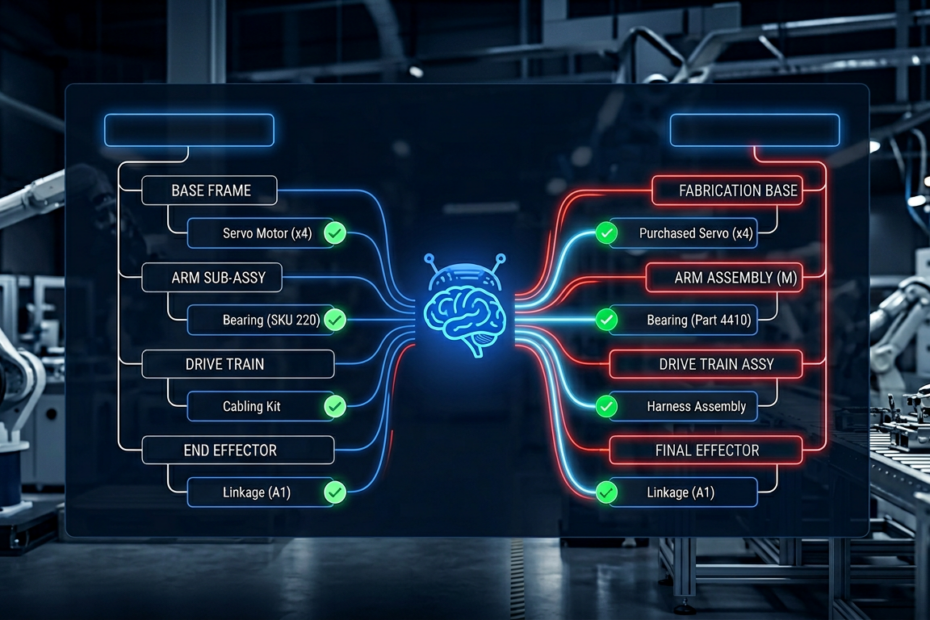
Bill of materials management is the backbone of manufacturing operations, and BOM reconciliation is where things consistently break down. The core challenge: engineering creates a design BOM (EBOM), manufacturing translates it into a manufacturing BOM (MBOM), and these two versions must stay aligned through every revision, substitution, and engineering change.
The EBOM-to-MBOM Alignment Problem
The engineering BOM defines what the product is. The manufacturing BOM defines how to build it. They are not the same. An EBOM might specify a “fastener assembly” as a single line item. The MBOM explodes that into three separate parts with specific torque specs and assembly sequence. An EBOM uses engineering part numbers; the MBOM maps to procurement part numbers and supplier SKUs. When engineering releases a new revision — changing a material spec, updating a dimension, substituting a component — the MBOM must be updated to match. In a typical mid-size manufacturer with 500 active BOMs, each averaging 30–50 line items, the reconciliation workload is staggering.
The manual cost: Industry surveys consistently show that manufacturers with 500+ active BOMs spend 20–30 hours per week on BOM reconciliation. That’s one full-time employee doing nothing but comparing spreadsheets, checking revision levels, and updating records. Error rates in manual reconciliation run 3–8%, and each error has downstream consequences: wrong parts ordered, production delays, scrap, and rework.
How AI Agents Automate BOM Reconciliation
AI-driven BOM reconciliation works by continuously comparing EBOM and MBOM structures and flagging discrepancies. Here’s the workflow:
- Ingestion: The agent reads EBOM data from your PLM or engineering system and MBOM data from your ERP. It understands multi-level BOM structures — parent-child relationships, phantom assemblies, reference designators.
- Comparison: For each EBOM revision, the agent compares against the current MBOM line by line. It identifies additions, deletions, quantity changes, material substitutions, and specification changes.
- Classification: Discrepancies are classified by severity. A material substitution affecting form, fit, or function is flagged as critical. A cosmetic change or alternate supplier part is flagged as informational. This classification uses both rule-based logic and AI pattern recognition from historical change data.
- Resolution routing: Critical discrepancies are routed to the appropriate reviewer (engineering, procurement, or quality) with context. Low-severity discrepancies can be auto-resolved based on predefined rules — for example, if the substitution is an approved alternate part already in the system.
- Update execution: Once approved, the agent updates the MBOM in the ERP system, creates the change record, and notifies downstream functions (procurement, production planning, costing).
The result: Manufacturers deploying AI BOM reconciliation report reducing reconciliation time from 20+ hours per week to 2–4 hours, with error rates dropping below 0.5%. The remaining human time is spent on genuine engineering judgment calls, not data comparison. For details on how AI handles engineering documents and drawings, see our CAD drawing intelligence capabilities.
Component Substitution Tracking
Component substitutions are a constant reality in manufacturing. A supplier discontinues a part. A material becomes unavailable. A cost reduction initiative requires a cheaper alternative. Each substitution must be validated (does the new part meet specs?), documented (for quality and regulatory traceability), and propagated (across every BOM that uses the affected component).
An AI agent tracks substitutions across all affected BOMs automatically. When a substitution is approved for one BOM, the agent identifies every other BOM using the same component and flags them for review or auto-updates them based on the approved substitution rules. This cross-BOM propagation, which takes hours manually, happens in minutes.
Multi-Level BOM Explosion
Manufacturing BOMs are hierarchical. A finished product BOM references sub-assemblies, which reference sub-sub-assemblies, which reference raw materials. A change at any level cascades up and down. AI agents handle multi-level explosion natively — they understand the full BOM tree and can trace the impact of a change from raw material to finished product or from finished product down to every affected purchased component. This is especially valuable for manufacturers with complex products: 5–10 levels of BOM depth is common in electronics, aerospace, and industrial equipment.
Order Processing: From Sales Order to Shop Floor
The path from a customer order to a work order on the shop floor is littered with manual steps that consume time and introduce errors.
Sales Order to Work Order Conversion
When a sales order comes in, someone must determine the required BOM configuration, check material availability, create a work order, assign it to a production line or work center, and schedule it. For make-to-order manufacturers, this process is repeated for every order — and each order may have unique configurations, quantities, and delivery requirements.
AI agents automate this conversion by reading the sales order, mapping it to the correct BOM and routing, checking inventory and capacity, generating the work order, and slotting it into the production schedule. For standard configurations, this happens without human intervention. For custom configurations, the agent prepares the work order with all standard elements pre-filled and flags the custom elements for human review. Manufacturers using AI-assisted order processing report reducing order-to-work-order conversion time from 30–45 minutes per order to under 5 minutes for standard orders.
Material Allocation and Availability Checking
Before a work order can be released to production, materials must be available. Manual availability checking involves looking up each BOM component in the ERP, checking on-hand quantity, checking incoming POs and their expected dates, and determining whether to allocate existing stock or wait for incoming material. For a work order with 40 components, this can take 20–30 minutes.
An AI agent performs this check in seconds, across all components simultaneously. It considers current inventory, allocated inventory (reserved for other orders), incoming supply, lead times for items that need to be ordered, and alternative locations or substitute parts. The output is a clear material availability report: ready to release, partially available (with expected completion date), or blocked (with a list of missing items and recommended actions). This feeds directly into AI-driven supply chain and inventory management.
Production Scheduling
With work orders created and materials confirmed, scheduling assigns work to machines, lines, and shifts. Manual scheduling — often done in spreadsheets or on whiteboards — breaks down when order volume is high, routings are complex, or disruptions occur (machine breakdowns, rush orders, material delays). AI scheduling agents optimize across constraints: machine capacity, tooling availability, operator skills, setup times, and due dates. They re-optimize in real time when conditions change, providing updated schedules within minutes rather than the hours it takes a human scheduler to replan. Mid-market manufacturers implementing AI scheduling report 10–20% improvement in on-time delivery and 15–25% reduction in setup time through better job sequencing.
Accounts Payable and Accounts Receivable Automation
Financial back-office operations in manufacturing are high-volume, rule-based, and error-prone — the ideal profile for AI automation.
Invoice Matching: 2-Way and 3-Way
Two-way matching compares a supplier invoice to the purchase order. Three-way matching adds the goods receipt to the comparison. In a mid-size manufacturer processing 500–1,000 invoices per month, manual matching consumes 40–80 hours of AP staff time monthly. Discrepancies — wrong quantities, price variances, missing line items — require investigation that adds more time.
AI agents automate matching by extracting invoice data (via OCR and document understanding), comparing it to PO and goods receipt records in the ERP, and classifying results: matched (auto-approve for payment), minor variance (within tolerance, auto-approve with notation), or discrepancy (route for human review with specific variance details). Manufacturers deploying AI invoice matching report auto-matching 70–85% of invoices without human intervention, reducing AP processing costs by 50–60% and accelerating payment cycle times by 30–40%.
Payment Terms Management
Different suppliers have different payment terms: Net 30, 2/10 Net 30 (2% discount for payment within 10 days), progress payments, milestone payments. Managing these across hundreds of suppliers is complex. AI agents track payment terms by supplier, calculate optimal payment timing (taking early payment discounts when cash flow permits), flag approaching deadlines, and generate payment runs. A manufacturer with 200 active suppliers and an average of 3 invoices per supplier per month processes 600 payments. Optimizing early payment discounts alone — which many manufacturers miss due to manual processing delays — can save 1–2% of annual procurement spend.
Supplier Statement Reconciliation
Monthly supplier statement reconciliation — comparing the supplier’s view of what you owe with your AP records — is tedious and time-consuming. Discrepancies arise from timing differences, unrecorded credits, disputed invoices, and data entry errors. AI agents automate this by comparing statement line items to your AP ledger, identifying matches, flagging discrepancies with likely explanations, and generating reconciliation reports. What previously took 1–2 hours per major supplier is reduced to a quick review of exceptions.
The Compliance Angle: European Manufacturing Requirements
European manufacturers face additional back-office complexity from regulatory requirements that make automation even more valuable.
- Documentation requirements: EU regulations require extensive documentation for product traceability, material declarations, and conformity assessment. AI agents generate and maintain this documentation automatically as part of the BOM and order processing workflow.
- Audit trails: ISO 9001, IATF 16949, AS9100, and other quality management standards require comprehensive audit trails for all changes to BOMs, work orders, and quality records. AI agents create immutable audit logs for every action — every BOM change, every order conversion, every invoice approval — with timestamps, user identification, and change details.
- REACH and RoHS compliance: Tracking restricted substances across multi-level BOMs is a significant burden. AI agents can flag components that require substance declarations, track compliance status across BOMs, and alert when a component substitution affects compliance.
- EU AI Act considerations: For manufacturers deploying AI in their operations, the EU AI Act (effective August 2025 for high-risk systems) requires documentation of AI system capabilities, limitations, and human oversight mechanisms. Back-office AI agents are generally classified as limited-risk, but proper documentation and transparency are still required.
The Hidden Cost of Manual Back-Office Processes
The true cost of manual back-office operations extends far beyond direct labor hours. Consider the full picture for a mid-size manufacturer with €50M revenue:
- Direct labor: 3–5 full-time employees dedicated to BOM management, order processing, and AP/AR — approximately €200K–€350K annually in total compensation
- Error costs: BOM errors causing wrong parts ordered, rework, and scrap — typically 0.5–1.5% of revenue, or €250K–€750K annually
- Delay costs: Late orders, missed payment discounts, and expediting fees from manual processing bottlenecks — €100K–€300K annually
- Opportunity cost: Engineering, procurement, and finance staff spending time on data entry and reconciliation instead of strategic work — unquantifiable but significant
Total addressable cost for a €50M manufacturer: €550K–€1.4M annually. AI automation targeting even 50% of this cost delivers €275K–€700K in annual savings — a compelling ROI on a typical €100K–€250K implementation investment.
Frequently Asked Questions
How long does it take to automate BOM reconciliation with AI?
A focused BOM reconciliation automation project takes 60–90 days from kickoff to production deployment. The first 2–3 weeks are spent on data integration (connecting to your PLM and ERP), the next 3–4 weeks on configuration and testing (defining reconciliation rules, severity classifications, and routing logic), and the final 3–4 weeks on production deployment with human-in-the-loop validation. Most manufacturers see measurable time savings within the first month of production use.
Does back-office automation require replacing our ERP system?
No. AI agents for back-office automation layer on top of your existing ERP system. They read data from and write data to your ERP via APIs or database connections. Your ERP remains the system of record. The AI handles the processing, comparison, and decision logic that your staff currently does manually between ERP screens. This approach works with all major mid-market ERPs including SAP Business One, Microsoft Dynamics 365, Epicor, and Infor.
What accuracy can I expect from AI invoice matching?
AI invoice matching achieves 95–98% accuracy on field-level extraction (invoice number, line items, quantities, amounts) for standard digital invoices. For scanned or handwritten invoices, accuracy drops to 88–93%. The practical outcome is that 70–85% of invoices are auto-matched with no human intervention required. The remaining 15–30% are routed for human review with the specific discrepancy highlighted — the human reviews the exception, not the entire invoice. Overall processing accuracy (including human review of exceptions) exceeds 99%.
Can AI handle our custom BOM structures and non-standard processes?
Yes, with configuration. Every manufacturer has unique BOM conventions, naming standards, and process variations. AI agents are configured to understand your specific structures — phantom assemblies, reference designators, alternative BOMs, configurable BOMs. The configuration happens during deployment, not as custom software development. If your BOM structures are highly unusual, expect a longer configuration period (add 2–4 weeks), but the underlying AI capabilities handle the complexity.
What’s the difference between AI automation and RPA for back-office tasks?
Robotic Process Automation (RPA) follows rigid scripts: click here, copy that, paste there. It breaks when screen layouts change, data formats vary, or exceptions occur. AI agents understand context: they can handle invoice format variations across suppliers, interpret BOM changes with engineering judgment, and route exceptions intelligently based on the type of discrepancy. For structured, repetitive tasks with zero variation, RPA works. For manufacturing back-office tasks — which involve constant variation, exceptions, and judgment — AI agents deliver significantly better results and lower maintenance costs.
Where to Start
The highest-ROI back-office automation targets for most mid-market manufacturers are, in order:
- BOM reconciliation — high frequency, high error cost, well-defined rules
- Invoice matching — high volume, measurable time savings, clear ROI
- Sales order to work order conversion — direct impact on throughput and delivery
- Supplier statement reconciliation — lower frequency but high pain when neglected
Pick the process that causes the most pain or consumes the most time and start there. A focused pilot delivers results in 60–90 days and builds the foundation for expanding to adjacent workflows. Kamna Ventures helps manufacturing SMBs automate back-office operations with agentic AI that integrates with existing ERP systems. Ready to stop reconciling spreadsheets? Start with our AI Incubation Lab to scope your first back-office automation project.