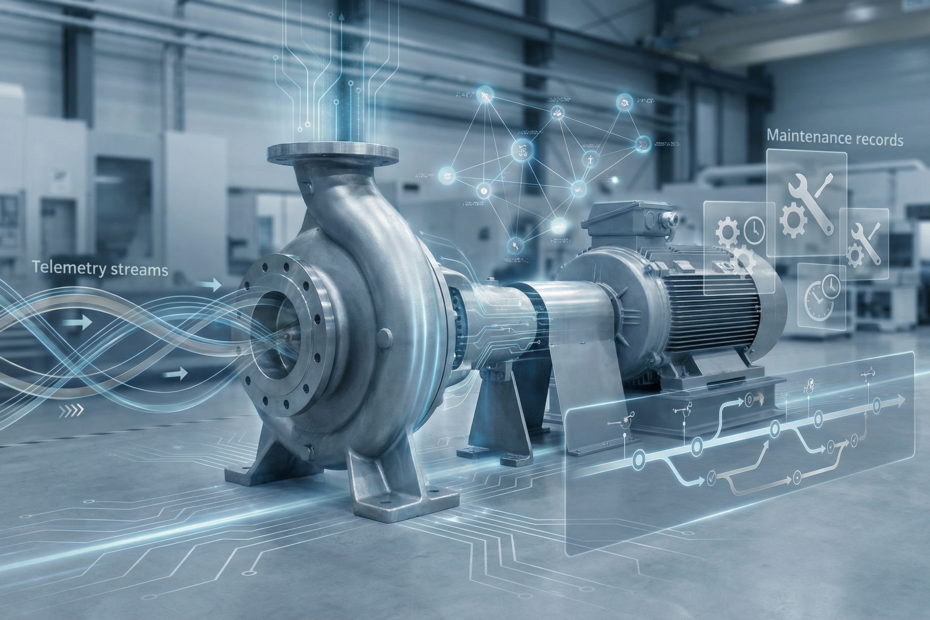
Most digital twin projects stop at dashboards. They collect telemetry and metadata, but they do not capture how decisions were made. That is the missing layer if you want agents that improve over time.
A production-ready pattern is to pair digital twins with a Context Graph: a unified decision-memory layer that links live signals, process context, documents, maintenance history, and operator actions.
The Core Pattern: Capture Decision Traces, Not Just Final Actions
Traditional systems log final state: “Work order created.” A context graph logs the full trace: trigger, evidence, rules, decision, approval, and outcome.
{
  "trace_id": "dt_20260221_001",
  "trigger": { "type": "alarm", "input": "Pump temperature high" },
  "entity": { "asset_id": "Pump_17", "asset_type": "Coolant Pump" },
  "context_gathered": {
    "telemetry": { "temperature_c": 85, "flow_lpm": 12 },
    "spec_limits": { "max_temp_c": 80 },
    "related_assets": [{ "asset_id": "CoolingLoop_3", "status": "degraded" }],
    "precedents": [{ "trace_id": "dt_20260103_883", "similarity": 0.91 }]
  },
  "decision": {
    "action": "throttle_and_create_work_order",
    "confidence": 0.87,
    "reasoning": "Exceeded thermal limit with degraded cooling loop"
  },
  "outcome": { "status": "successful", "linked_work_order": "WO-14882" }
}
Reference Data Architecture (Polyglot by Design)
- PostgreSQL: asset metadata, maintenance, work orders, decision traces
- InfluxDB: high-frequency telemetry and anomalies
- Neo4j: asset, process, and dependency relationships
- Search index: SOPs, manuals, troubleshooting docs
- Object store: CAD, images, videos, inspection artifacts
Schema Example for Searchable Precedents
CREATE TABLE decision_traces (
  id BIGSERIAL PRIMARY KEY,
  trace_id TEXT UNIQUE NOT NULL,
  trigger_type TEXT,
  asset_id TEXT,
  context_gathered JSONB,
  reasoning TEXT,
  decision_action TEXT,
  decision_confidence NUMERIC,
  outcome_status TEXT,
  created_at TIMESTAMP DEFAULT NOW()
);

CREATE INDEX idx_decision_traces_asset ON decision_traces(asset_id);
CREATE INDEX idx_decision_traces_outcome ON decision_traces(outcome_status);
Agent API Pattern
// 1) Read unified context
GET /api/context-graph/:assetId

// 2) Execute recommendation with human-in-loop
POST /api/agents/digital-twin/query

// 3) Persist trace for future precedent search
POST /api/context-graph/decision-trace

// 4) Find similar cases
GET /api/context-graph/search-precedents?asset_type=pump&symptoms=high_temp
Implementation Checklist
- Define trace schema and instrument every agent decision path.
- Build a context aggregator service that joins telemetry, graph, docs, and maintenance data.
- Add precedent search before action recommendation.
- Require approval gates for high-risk actions.
- Track outcome quality to improve ranking of future precedents.
Bottom line: digital twins become far more valuable when paired with agents that remember operational reasoning, not just values. That is what turns a twin from passive monitoring into active, improving intelligence.